

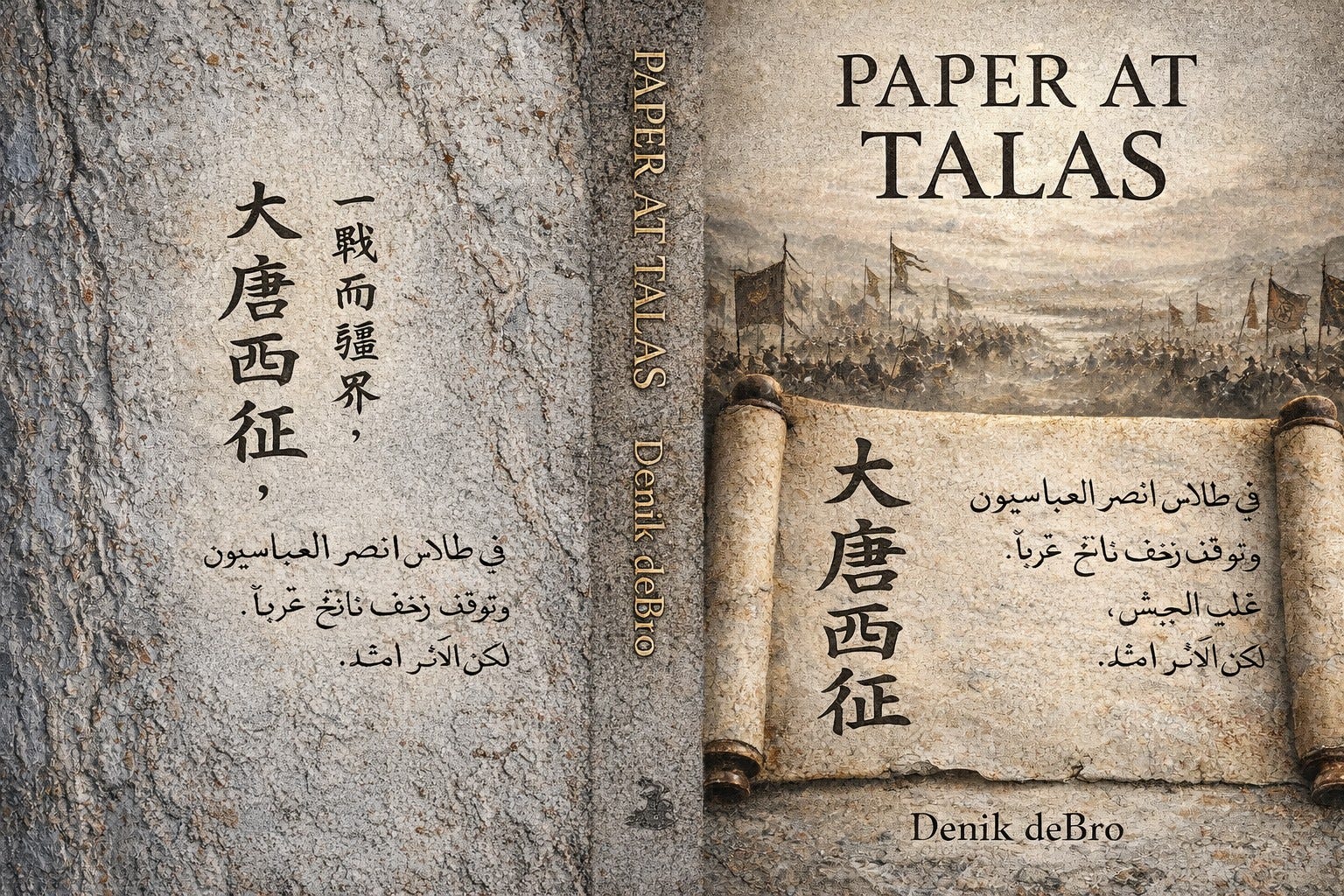
Paper at Talas

What if the most powerful weapon in history was not a sword-but a sheet of paper?
In the year 751, two empires collide on the banks of the Talas River. The Tang Dynasty marches west. The Abbasid Caliphate rises from the desert. Armies clash in a battle that most history books barely mention-yet its consequences quietly reshape the world.
At the center of this turning point are three unlikely figures.
Li Wei, a Chinese paper artisan bound by generations of secrecy, knows the fragile craft that turns water and fiber into the most dangerous substance an empire can possess. His family believes paper must remain controlled-or chaos will follow.
Samira bint Nadir, a Samarkand copyist forbidden to author her own ideas, discovers something radical in the margins of texts she secretly annotates. When she encounters paper for the first time, she realizes knowledge can travel faster than power.
Yusuf ibn Rashid, an Abbasid logistics officer obsessed with numbers and efficiency, sees what others cannot: paper will transform administration, war, and governance itself. Ledgers will soon move faster than armies.
When the Tang army collapses at the Battle of Talas, captured artisans bring papermaking westward. What begins as a tool of empire becomes something far more dangerous.
Paper multiplies.
Margins fill with dissent.
Ideas travel where rulers cannot follow.
As knowledge escapes the control of kings, scholars, and priests, a new age begins-one where memory no longer belongs to emperors.
Paper at Talas is a sweeping historical novel about the moment the world changed quietly, when a humble technology began to spread across civilizations, carrying with it the most disruptive force humanity has ever known:
The written voice of anyone.
Unfortunately, a lot of people do not care about paper, mainly because paper has existed before their birth.