
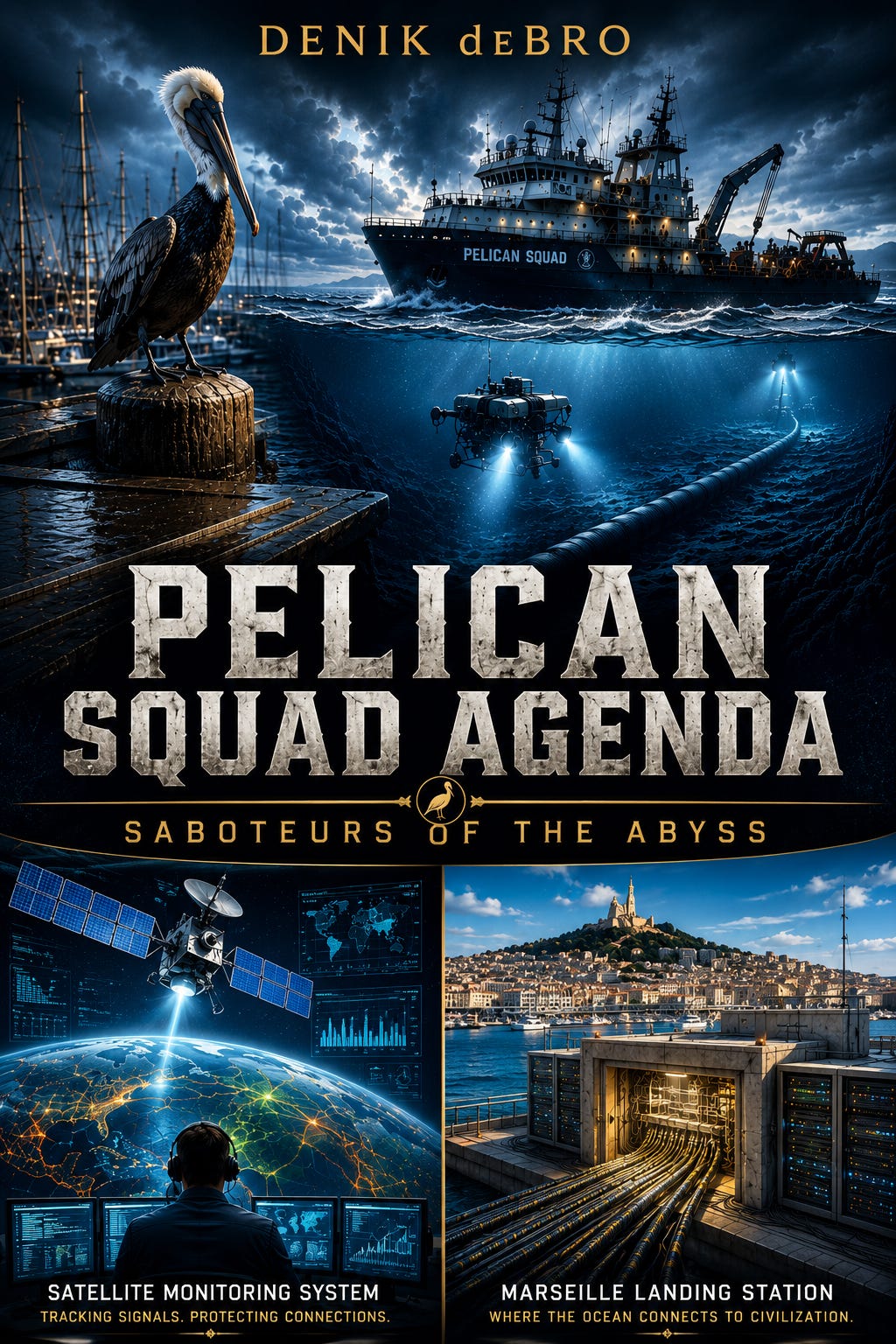
The world believed the internet lived in satellites, clouds, and data centers.
It was wrong.
Nearly all global communications—financial transactions, military intelligence, air traffic coordination, emergency systems, streaming media, diplomatic channels, and the daily pulse of civilization—travel through fragile fiber-optic cables lying silently across the ocean floor.
When multiple submarine cable routes begin failing without explanation, the disruptions appear minor at first: delayed transactions, distorted signals, unexplained routing anomalies. But within days, markets destabilize, shipping lanes lose synchronization, insurance systems panic, and entire regions begin slipping into digital darkness.
Far beneath the headlines, an aging multinational repair vessel named Pelican Dawn receives an emergency deployment.
Its commander, Captain Elias Vey, has spent his life repairing infrastructure nobody notices until it breaks. Quiet, exhausted, and deeply respected among maritime repair crews, Elias leads a volunteer team of saturation divers, fiber-optic engineers, seabed cartographers, and emergency technicians into increasingly hostile waters where storms, crushing depths, rogue autonomous drones, and geopolitical secrecy converge.
As the failures spread from the Pacific to the Atlantic and into the Arctic corridors, the crew discovers something terrifying:
The cables are not failing naturally.
They are being hunted.
What begins as a repair mission evolves into a hidden war fought beneath the sea—an invisible conflict over data sovereignty, economic control, autonomous systems, and the fragile nervous system of modern civilization itself.
Hana Seo, a Korean-American repeater specialist, uncovers impossible damage patterns hidden inside recovered cable sections. Mateo Ruiz, a veteran saturation diver haunted by an earlier abyssal disaster, descends into lethal depths where something unseen stalks repair operations. Cybersecurity strategist Naomi Mercer traces ghost-routing anomalies that suggest the sabotage campaign may be coordinated by adaptive AI systems. Investigative journalist Idris Vale follows the widening blackouts toward a conspiracy governments refuse to acknowledge.
Meanwhile, unmarked ships move through dead waters without identification. Insurance markets begin collapsing under infrastructure uncertainty. Autonomous underwater machines patrol the abyss. Entire nations accuse each other of covert attacks while ordinary civilians struggle to remain connected to the world above the waves.
And scattered across forgotten harbors and aging repair docks, an old maritime brotherhood quietly begins to awaken:
The Last Matroos Network.
They are the remaining cable sailors, harbor machinists, analog navigators, retired divers, and repair captains who spent decades maintaining the invisible machinery of civilization without recognition. In a world increasingly ruled by automation, algorithms, and privatized warfare, they may become humanity’s final line of resilience.
From typhoon walls over Guam to Arctic transmission corridors beneath polar ice, from abyssal vaults buried under pressure to abandoned shipping lanes drifting in silence, Pelican Squad Agenda: Saboteurs of the Abyss unfolds as a vast maritime techno-thriller about infrastructure warfare in the twenty-first century.
Cold, cinematic, and frighteningly plausible, the novel combines deep-sea suspense, geopolitical tension, industrial realism, and human endurance in the spirit of The Hunt for Red October, Das Boot, The Abyss, and the techno-thriller tradition of Michael Crichton and Tom Clancy.
Because the next world war may not begin in the skies or on land.
It may begin quietly—
with a severed cable lying in darkness beneath the sea.