

Substack vs. Amazon KDP: Which Is More Feasible for Long-Term Success?

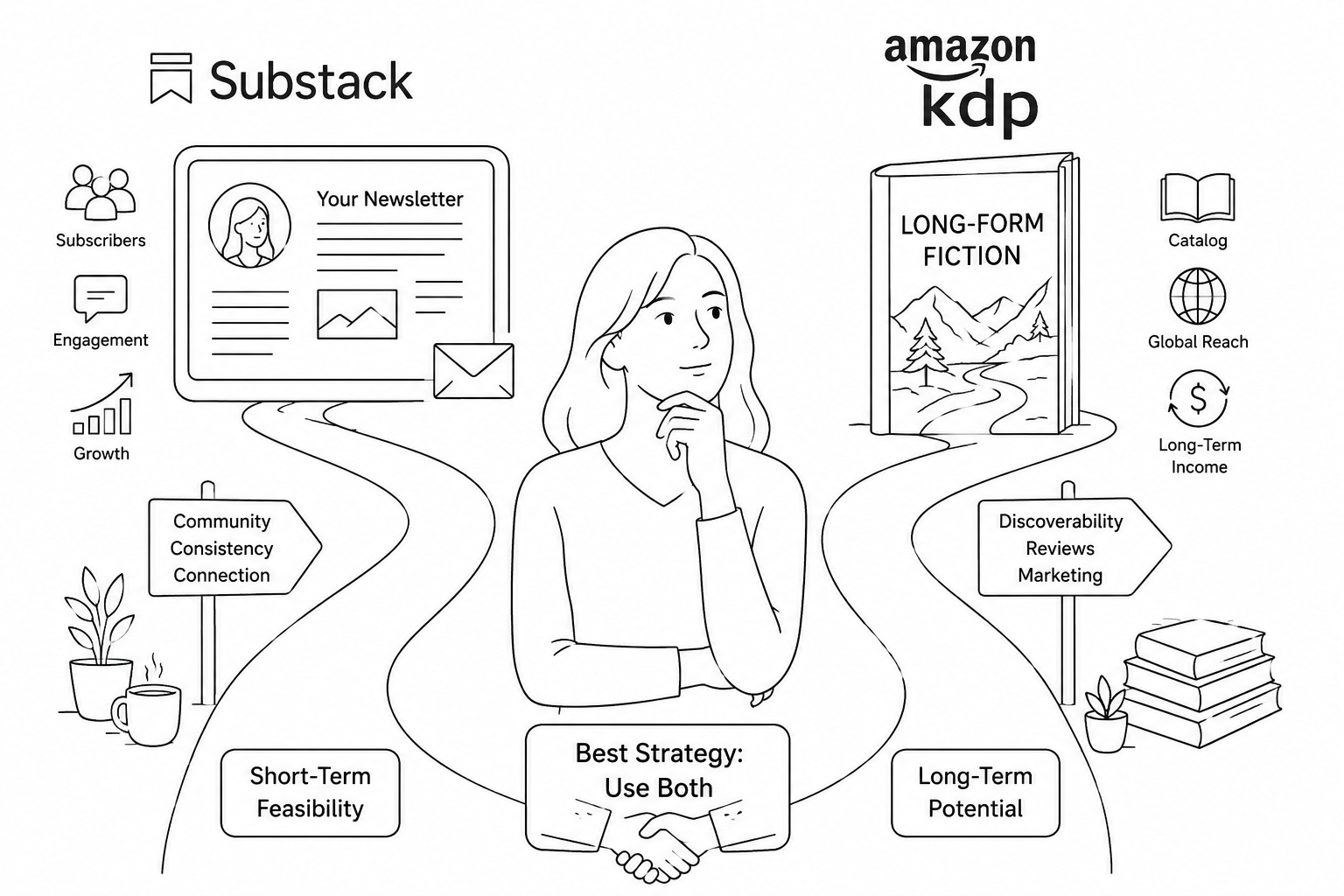
In my view, gaining bestseller status on Substack is generally more feasible in the short term, while independently publishing long-form fiction through Amazon KDP offers greater long-term potential.
Substack rewards consistency, personality, and direct engagement with readers. A writer can build an audience gradually through newsletters, comments, recommendations, and social sharing. Success depends less on competing with millions of books and more on developing a loyal community. A well-written newsletter can attract subscribers even before a major body of work is completed. Because readers subscribe to the author as much as the content, growth can be steady and cumulative.
Amazon KDP, on the other hand, places a novel in direct competition with an enormous global catalog. Reaching bestseller status often requires strong marketing, reviews, advertising, and a degree of luck. Many excellent novels remain undiscovered. The challenge is especially great for new authors without an existing readership.
However, over a longer time horizon, KDP has significant advantages. Books remain available indefinitely, can generate income for years, and can accumulate visibility through multiple titles. Each new book strengthens the author’s catalog and creates opportunities for cross-promotion. A novelist with several quality books may continue earning long after publication.
Therefore, if the goal is to achieve recognition quickly, Substack may be the more attainable path. If the goal is to build a lasting literary asset and a growing body of work over many years, publishing long-form fiction through Amazon KDP is likely the more sustainable strategy. Ideally, an author should use both: Substack to build readers and KDP to sell books.